Fresh vs. Dried Dates: What Is the Real Difference?
Are the brown, wrinkled dates in a supermarket box fresh fruit or dried fruit? The honest answer is that the usual two-category explanation is too simple. Some dates are eaten while crisp and brightly colored. Others soften, darken, and lose moisture naturally as they ripen. Some are dried further after harvest, and freeze-dried dates belong to another category again.
That is why a soft Medjool can be sold as a fresh date even though it looks more like a prune than a grape. It is also why the words *fresh* and *dried* do not tell you everything about sweetness, texture, storage, or nutrition.
This guide separates the stages and processes so you can compare fresh dates vs dried dates without the usual shortcuts. If you first want to compare Khidri, Medjool, and Khalas as varieties, read our guide to the best dates in the UAE.
Blog
The Short Answer
Fresh and dried dates are not always two completely different products.
- Khalal dates are mature but still firm and crisp, usually yellow or red. They are commonly understood as fresh dates.
- Rutab dates are softer, browner, and moister. They are also sold as fresh fruit and are highly perishable.
- Tamr dates are fully ripe and have lost more moisture. Most familiar brown dates are eaten at this stage, but Tamr can be soft, semi-dry, or dry depending on the variety.
- Conventionally dried dates have had additional moisture removed after harvest by sun, warm air, or another dehydration method.
- Freeze-dried dates have moisture removed by a distinct low-temperature drying process, creating a light, crisp texture rather than the dense chew of ordinary dried dates.
The most useful question is not simply, “Is this date fresh or dried?” Ask which ripening stage it reached, whether it was dried after harvest, what variety it is, and what the package says.
Why Fresh Dates vs Dried Dates Is More Complicated Than It Sounds
With most fruit, *fresh* suggests juicy produce and *dried* suggests a separate shelf-stable product. Dates blur that line because substantial moisture loss is part of their normal maturation.
A date can move from hard and colorful to soft and brown while still on the palm. If it continues ripening under suitable conditions, it becomes Tamr, the fully ripe stage familiar to most shoppers. This natural transformation includes softening, browning, sugar changes, and water loss. It does not automatically mean the fruit went through an industrial dryer.
The Food and Agriculture Organization's technical overview of whole dates describes three commercial stages at which dates may be eaten: Khalal, Rutab, and Tamr. It also distinguishes natural ripening from later treatments such as sun-drying, dehydration, hydration, curing, and pressing.
Retail language is less precise. One seller may call every unpackaged date “fresh.” Another may reserve that word for yellow Khalal or soft Rutab. A nutrition article may compare one high-moisture cultivar with one low-moisture product and label the difference simply as fresh versus dried.
That inconsistency explains why two apparently authoritative charts can disagree. They may not be comparing the same variety, maturity stage, serving size, or processing method.
The Four Date Ripening Stages
Dates pass through recognizable stages as they develop. Spellings vary across English sources, so you may see Khalal or Khalaal and Tamr or Tamar.
| Stage | Typical appearance and texture | Is it commonly eaten? | What the name tells you |
|---|---|---|---|
| Kimri | Green, hard, and not fully developed | Generally no | An early growth stage with high moisture and acidity |
| Khalal | Full-sized, firm, crisp, yellow or red depending on variety | Yes, for suitable varieties | The fruit is mature but still crunchy and relatively high in moisture |
| Rutab | Partly or fully brown, soft, juicy, and delicate | Yes | Ripening and moisture loss have progressed; the fruit is highly perishable |
| Tamr | Amber to dark brown, fully ripe, with texture ranging from soft to firm | Yes | The final ripening stage, with lower moisture than Rutab |
The transition is not identical for every cultivar. The FAO notes that only some varieties are palatable at Khalal because the loss of astringency happens at different rates. Variety and growing conditions also affect the final color, size, moisture, and texture.
A 2025 peer-reviewed review of Khalal date preservation describes the stage as crunchy, seasonal, and perishable. As the date advances toward Rutab and Tamr, firmness falls, color darkens, and the sensory balance changes.
Khalal: the clearest example of a fresh date
If you buy a bunch of crisp yellow Barhi dates during the season, the word *fresh* feels intuitive. Khalal dates contain considerably more water than fully ripe Tamr, bruise more like fresh produce, and have a short market window. Their taste can combine sweetness with a drying sensation from remaining tannins.
Not every cultivar is pleasant at this stage. For dates intended to be eaten as Khalal, freshness means firmness, clean skin, characteristic color, and no signs of decay. It does not mean the fruit will taste like a fully ripe brown date.
Rutab: fresh, soft, and easy to misunderstand
Rutab is the stage where the crisp fruit begins to soften and brown. A single date can sometimes show both stages at once, with a firmer yellow area and a softer brown area.
Rutab is still described and sold as fresh fruit, but it is much softer and more fragile than Khalal. The lower part of the fruit may look translucent or caramel-like. Its higher moisture makes refrigeration and prompt use important. Our separate guide explains how to store dates in the UAE by maturity and format.
Tamr: fully ripe does not always mean artificially dried
Tamr is the final ripening stage. The fruit has lost more moisture, deepened in color, and developed the familiar concentrated date character. It may be soft and pliable, semi-dry and chewy, or genuinely firm and dry.
This is the distinction many quick comparisons miss: a Tamr date can reach its lower-moisture condition through ripening on the palm. Producers may also dry dates further after harvest for safety, stability, texture, or market requirements. Looking at a brown date cannot tell you which handling steps it received.
Fresh Dates vs Dried Dates at a Glance
| Feature | Khalal or Rutab “fresh dates” | Tamr dates | Conventionally dried dates | Freeze-dried dates |
|---|---|---|---|---|
| Main reason for moisture difference | Earlier maturity stage | Further natural ripening and water loss | Additional postharvest dehydration | Moisture removal through freeze-drying |
| Typical texture | Crisp at Khalal; soft and juicy at Rutab | Soft, chewy, semi-dry, or firm | Dense, chewy, leathery, or firm | Light, porous, and crisp |
| Color | Yellow or red at Khalal; browning at Rutab | Amber to dark brown | Often brown and more shriveled | Depends on the starting fruit; usually light and dry inside |
| Storage sensitivity | High, especially Rutab | Varies by moisture, variety, and packaging | Often more stable when properly dried and packed | Highly sensitive to humidity after opening |
| Best buying clue | Stage name, harvest timing, appearance | Variety, texture class, label | Label and producer description | The words “freeze-dried” plus a dry, crisp format |
| Does the category prove added sugar? | No | No | No | No |
This table is a guide, not a legal classification for every market. Product labels, national standards, and trade terminology can use the words differently.
Are Medjool Dates Fresh or Dried?
Most packaged Medjool dates are fully ripe dates, usually sold at the Tamr stage. They can be marketed as fresh dates even though they are brown, wrinkled, sweet, and much less watery than Khalal fruit.
Some Medjool dates lose enough moisture naturally to reach the desired texture. Others may receive controlled drying, conditioning, or other postharvest handling. The word *Medjool* identifies a cultivar, not a drying method. You cannot determine the full process from the variety name alone.
If the distinction matters to you, check the package or ask the producer:
1. Is the product simply whole Medjool dates? 2. Does the label describe them as fresh, dried, dehydrated, or conditioned? 3. Are any ingredients listed besides dates? 4. What storage instructions are provided?
Do not assume that a soft Medjool is “raw” or completely unprocessed just because the ingredient list says dates. Washing, sorting, cold storage, pest-control measures, and moisture adjustment can all be part of postharvest handling without adding another food ingredient.
Fresh Dates vs Dried Dates Nutrition
The simplest nutrition claim is that dried dates contain more calories and sugar than fresh dates. It is often directionally true per 100 grams when the dried sample contains much less water, but that sentence leaves out the most important comparison details.
Water changes the numbers per gram
Removing water makes the remaining components more concentrated by weight. Imagine weighing 100 grams of juicy Rutab and 100 grams of lower-moisture dates. The second portion contains less water, so it can fit more date solids, including naturally occurring sugars, into the same weight.
That does not mean drying added sugar. It means the denominator changed.
The same issue appears with calories, fiber, and minerals. A lower-moisture product may show more of several nutrients per 100 grams because more fruit solids fit into that amount. If you compare one date with one date, or a realistic serving with another realistic serving, the result may look different.
Variety and maturity also change composition
Water is not the only variable. During ripening, sugars, organic acids, tannins, pigments, and texture-related compounds change. Different cultivars follow different patterns.
A 2026 study indexed by PubMed used metabolomic and mineral profiling to examine dates across four developmental stages. It found clear stage-specific differences, including changes in simple sugars, acids, flavonoids, lipids, and minerals as fruit matured.
This is useful evidence that a date's maturity matters. It is not proof that one stage treats or prevents any disease, and it does not create a universal nutrition table for all cultivars. The study analyzed biochemical composition, not health outcomes in people.
How to make a fair comparison
When comparing two products, use the current nutrition labels and check all four points:
- Serving basis: Are both values per 100 g, per serving, or per piece?
- Serving size: How many dates or grams will you actually eat?
- Ingredients: Is the product plain fruit, or does it contain syrup, sugar, oil, chocolate, or a filling?
- Product type: Are you comparing the same cultivar and maturity, or two fundamentally different formats?
For a closer look at labels, serving sizes, and concentration, see our guide to dried fruit nutrition facts. If your real question is whether dates are a better sweetener than table sugar, our article Are dates healthier than sugar? compares whole dates, date paste, date sugar, and date syrup separately.
Do Dried Dates Have More Sugar?
There are two different questions hiding here.
Do dried dates have more naturally occurring sugar per 100 grams?
They often can, because lower water content concentrates the fruit solids. But the exact difference depends on the varieties, stages, and products being compared. A fixed number copied from a generic database may not match the pack in your hand.
Does drying add sugar?
No. Drying itself removes moisture; it does not automatically add sugar. Plain dried dates can have a one-item ingredient list: dates.
Some date products do include added sweeteners, coatings, fillings, or syrups. The front of the package may use broad language, so the ingredient list and nutrition panel are the better evidence. “Dried” and “sweetened” are not synonyms.
Dates remain a concentrated source of carbohydrate and natural sugar, whether the front says fresh, dried, or freeze-dried. People who monitor carbohydrate intake for diabetes or another medical reason should use the actual serving and label, and follow advice from a qualified health professional rather than treating one category as unlimited.
How Texture and Flavor Change
The fresh-versus-dried decision is often more useful as a sensory choice than as a health contest.
Khalal
Expect a clean snap, a fresh-fruit feel, and a taste that may combine sweetness with mild astringency. Khalal works well when you want contrast beside soft cheese, yogurt, or a hot drink.
Rutab
Rutab is tender, moist, and almost melting. Its delicate texture makes it appealing on a plate but less convenient for carrying around. Serve it simply so the fresh seasonal character remains the focus.
Soft Tamr
Soft fully ripe dates offer a dense, caramel-like chew. They are easy to split and fill with nuts, pair with Arabic coffee, or blend into recipes. Their flavor and sweetness vary by cultivar.
Semi-dry or dry Tamr
These dates are firmer, less sticky, and often easier to handle. The bite may be chewy or fibrous rather than melting. They can suit travel, chopping, baking, and longer storage when the label supports it.
Conventionally dried dates
Additional drying can produce a denser and more leathery texture. The experience depends on starting material and method, so do not expect every product labeled dried to feel the same.
Freeze-dried dates
Freeze-drying creates a radically different structure: dry, porous, and crisp. Instead of becoming denser as moisture leaves, the fruit can become lighter and brittle. That texture difference is why freeze-dried dates deserve their own category rather than being grouped casually with chewy dried dates.
How to Choose the Right Date for the Job
There is no single winner between fresh dates and dried dates. Choose by the experience and use you want.
| You want to... | A useful starting point | Why |
|---|---|---|
| Experience the UAE date season | Khalal or Rutab from a reliable seller | These stages are seasonal, distinctive, and unlike year-round boxed dates |
| Serve a soft date with Arabic coffee | Soft Tamr, Medjool, Khalas, or another suitable cultivar | A tender chew and deep sweetness balance unsweetened coffee |
| Add chopped dates to baking | Semi-dry or firmer Tamr | Firmer fruit is often easier to cut and distribute through dough |
| Blend a whole-fruit sweetener | Soft, pitted whole dates | They soften and blend more readily; adjust liquid to the recipe |
| Carry dates for a day out | A securely packed, lower-moisture product | It is generally less fragile and sticky, but still needs protection from UAE heat |
| Add crunch to yogurt or a snack board | Freeze-dried dates | Their dry, crisp texture creates contrast |
Buying fresh dates in the UAE
For Khalal and Rutab, buy from a seller with clean handling and appropriate temperature control. Look for fruit that matches the expected stage, without fuzzy growth, sour or alcoholic odor, leaking liquid, or severe skin damage.
The season and cultivar will shape what is available. The Khalal window can be brief, while packaged Tamr is sold throughout the year. Do not reject normal color variation: yellow, red, amber, brown, and very dark fruit can all be appropriate depending on stage and variety.
Read the label before trusting the category
A useful label should help you answer:
- What is the product called?
- Is the ingredient list only dates, or are other ingredients present?
- What is the serving size?
- Does it need refrigeration after opening?
- What best-before date and storage directions apply?
- Does the producer identify a special process such as dehydration or freeze-drying?
If the seller makes a specific nutrition claim, compare it with the declared serving and nutrition panel. Do not infer that *natural*, *fresh*, *dry*, or *premium* means sugar-free, low-calorie, or suitable for every diet.
Storage Is About Moisture, Packaging, and Temperature
Fresh Khalal and Rutab require more careful cold handling than lower-moisture dates. Tamr storage varies because Tamr itself ranges from soft to dry. Pitted, chopped, stuffed, and coated products introduce additional variables.
UC Davis' date postharvest fact sheet notes that cultivars differ in moisture and storage behavior. It also explains that dates can absorb moisture at high relative humidity when packaging is not moisture-proof and can pick up strong odors.
In a UAE home, keep dates away from parked cars, sun-heated windows, cooking steam, and cupboards beside hot appliances. Follow the pack first. Refrigerate moist or perishable dates as directed, and keep dry or freeze-dried products tightly sealed against humidity.
For product-specific detail, use our complete UAE date storage guide. It covers pantry, refrigerator, freezer, spoilage signs, sugar spotting, opened packs, and serving trays.
Freeze-Dried Dates Are a Separate Category
“Dried dates” usually makes people picture a dense, brown, chewy fruit. Freeze-dried dates are different in both process and eating experience.
Freeze-drying removes moisture under low-temperature, reduced-pressure conditions after freezing. The customer-facing result is the important part: a dry, light, porous structure with a crisp bite. Because that structure readily takes up moisture from the air, the product needs tightly closed packaging in the UAE's humid conditions.
It is still date fruit. Freeze-drying does not make the fruit sugar-free or erase its carbohydrates. A fair comparison should use the serving size and nutrition panel, just as it would for fresh or conventionally dried dates.
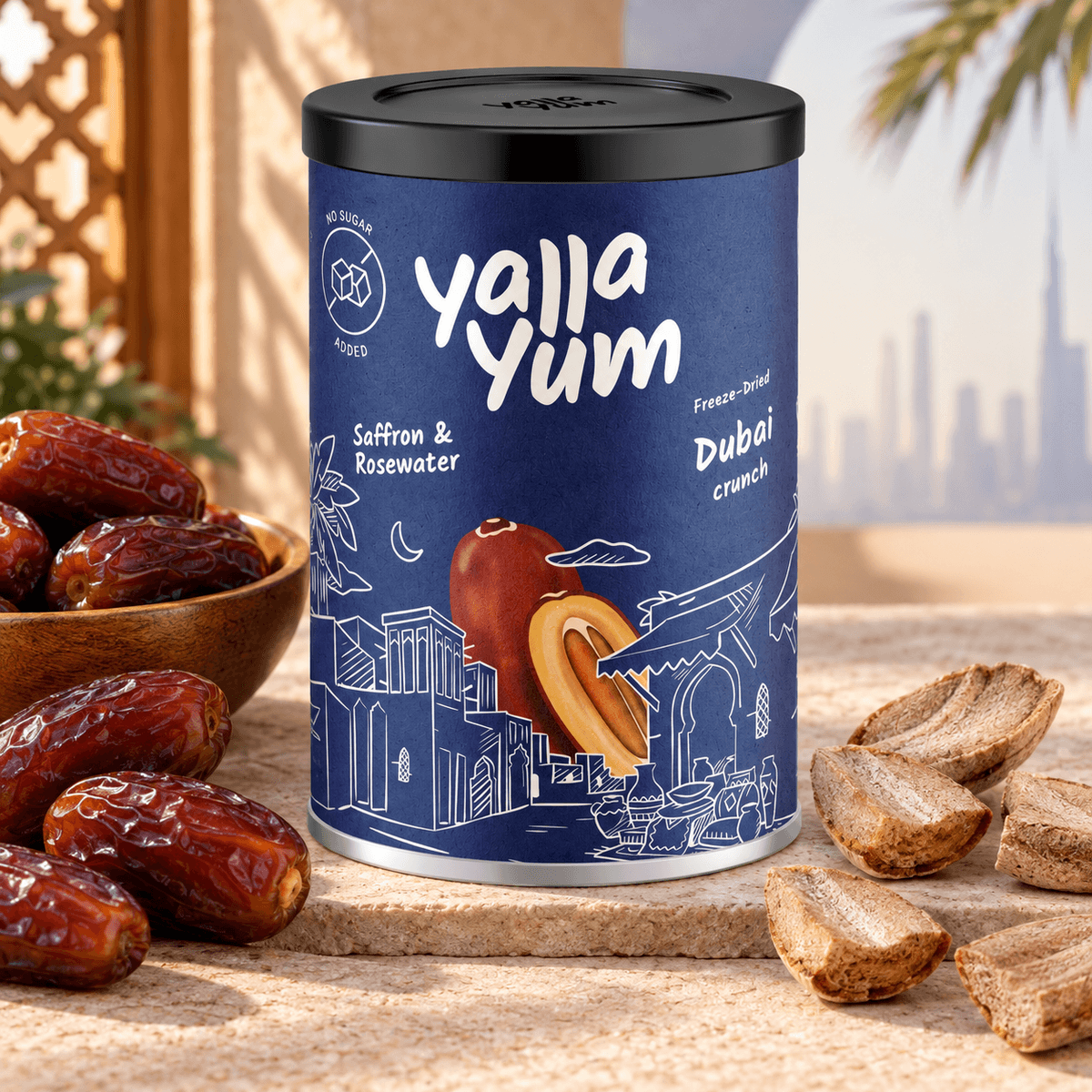
YallaYum's Dubai Crunch is made with organic Khidri dates, real regional flavors, and no added sugar, then freeze-dried in Dubai for a light, crisp texture. The two current 30 g resealable cans are Saffron & Rosewater and Cardamom & Cinnamon.
Dubai Crunch is not presented as a nutritional substitute for every fresh date. It offers a different texture and serving occasion: a crisp snack, coffee pairing, topping, or Dubai-made gift. The complete What Is Dubai Crunch? guide explains the flavors and uses without revealing YallaYum's detailed production know-how.
Common Myths About Fresh and Dried Dates
Myth 1: Every brown date has been industrially dried
Brown color and lower moisture also develop during normal ripening from Rutab to Tamr. Some dates are dried or conditioned after harvest, but appearance alone does not prove the method.
Myth 2: A date labeled fresh must be crisp and juicy
Soft Rutab and many fully ripe dates are sold as fresh. In date trade, *fresh* can refer to a product category broader than the everyday image of fresh fruit.
Myth 3: Dried dates always contain added sugar
Plain dried dates can contain only dates. Natural sugars become more concentrated per gram as water decreases. Added sugar is a separate ingredient question.
Myth 4: Medjool means dried
Medjool is a cultivar. It does not identify whether the fruit was dried after harvest. The package and producer are the sources for that detail.
Myth 5: Fresh dates are always nutritionally superior
The answer depends on the nutrient, serving basis, maturity, cultivar, and purpose. Higher water content may mean less sugar and energy per 100 grams, while lower water can concentrate fruit solids. “Superior” is too broad to be useful.
Myth 6: Freeze-dried and conventionally dried dates are interchangeable
Both have less moisture, but their structures and textures are very different. Ordinary dried dates are generally dense and chewy. Freeze-dried dates are light and crisp and need strong protection from humidity.
Frequently Asked Questions
What is the main difference between fresh and dried dates?
Fresh dates usually refer to higher-moisture Khalal or Rutab fruit, although fully ripe dates may also be marketed as fresh. Dried dates have lower moisture, either through natural ripening or additional dehydration. Check the maturity stage, variety, label, and process rather than relying on appearance alone.
Are Medjool dates fresh or dried?
Medjool is a date variety, not a processing category. Most packaged Medjool dates are fully ripe and may be sold as fresh even though they are brown and wrinkled. Some may receive drying or conditioning after harvest, so consult the label or producer for the exact handling method.
What is the difference between Rutab and Tamr dates?
Rutab is a soft, moist stage in which the fruit has begun browning and remains perishable. Tamr is the final ripe stage after further moisture loss. Tamr dates may still be soft, but they can also be semi-dry or firm depending on cultivar and growing conditions.
Do dried dates contain added sugar?
Not necessarily. Plain dried dates can have only one ingredient: dates. Their natural sugars may appear more concentrated per 100 grams because drying removes water. Sweetened, coated, or filled date products may contain added sugar, so use the ingredient list and nutrition panel instead of the word “dried.”
Are fresh dates lower in sugar than dried dates?
Higher-moisture dates often contain less sugar per 100 grams because more of the weight is water. Results change with cultivar, maturity, and serving basis. Compare the actual labels in equal units, then consider how many pieces you will eat. Drying does not by itself create new sugar.
Is Tamr the same as a dried date?
Tamr means the final ripening stage, not one specific drying process. A date can become lower in moisture as it ripens into Tamr on the palm. It may also be dried or conditioned further after harvest. Ask the producer if the postharvest method matters to your purchase.
How should fresh dates be stored in the UAE?
Khalal and especially Rutab should generally be kept refrigerated in clean, protective packaging and used according to the seller's directions. Soft opened dates also benefit from refrigeration. Keep all dates away from cars, sunlight, heat, and steam, and follow the current package label before generic online advice.
Are freeze-dried dates the same as regular dried dates?
No. Regular dried dates are usually dense, chewy, or leathery. Freeze-dried dates have a dry, porous structure and a light, crisp bite. Both contain the date's natural sugars, but they behave differently in storage. Freeze-dried products must be tightly resealed to protect them from humidity.
Fresh Dates vs Dried Dates: The Bottom Line
The most accurate comparison is not a battle between two boxes labeled fresh and dried. Dates move through Khalal, Rutab, and Tamr, losing moisture and changing texture as they ripen. Additional drying may happen after harvest, but Tamr is not automatically proof of industrial dehydration.
Choose Khalal for a crisp seasonal experience, Rutab for soft fresh-fruit character, Tamr for the familiar rich chew, and conventionally dried dates when a firmer, lower-moisture format suits the job. Choose freeze-dried dates when you want the fruit in a genuinely crisp form.
Then read the label. Variety, maturity, serving size, ingredients, storage directions, and processing description tell you more than a single marketing word ever can.
Ready to experience dates from a different angle? Explore Dubai Crunch by YallaYum or browse the full YallaYum shop.
Editorial Note
This article was researched and written by the YallaYum editorial team. It was reviewed for food-safety accuracy by Mohammad Ali, Certified Food Safety Person in Charge (PIC), MSc Mechanical Engineering, with five years of food-industry experience. It provides general educational information and does not replace individualized medical or dietary advice.