Best Dates in the UAE: Khidri, Medjool, and Khalas
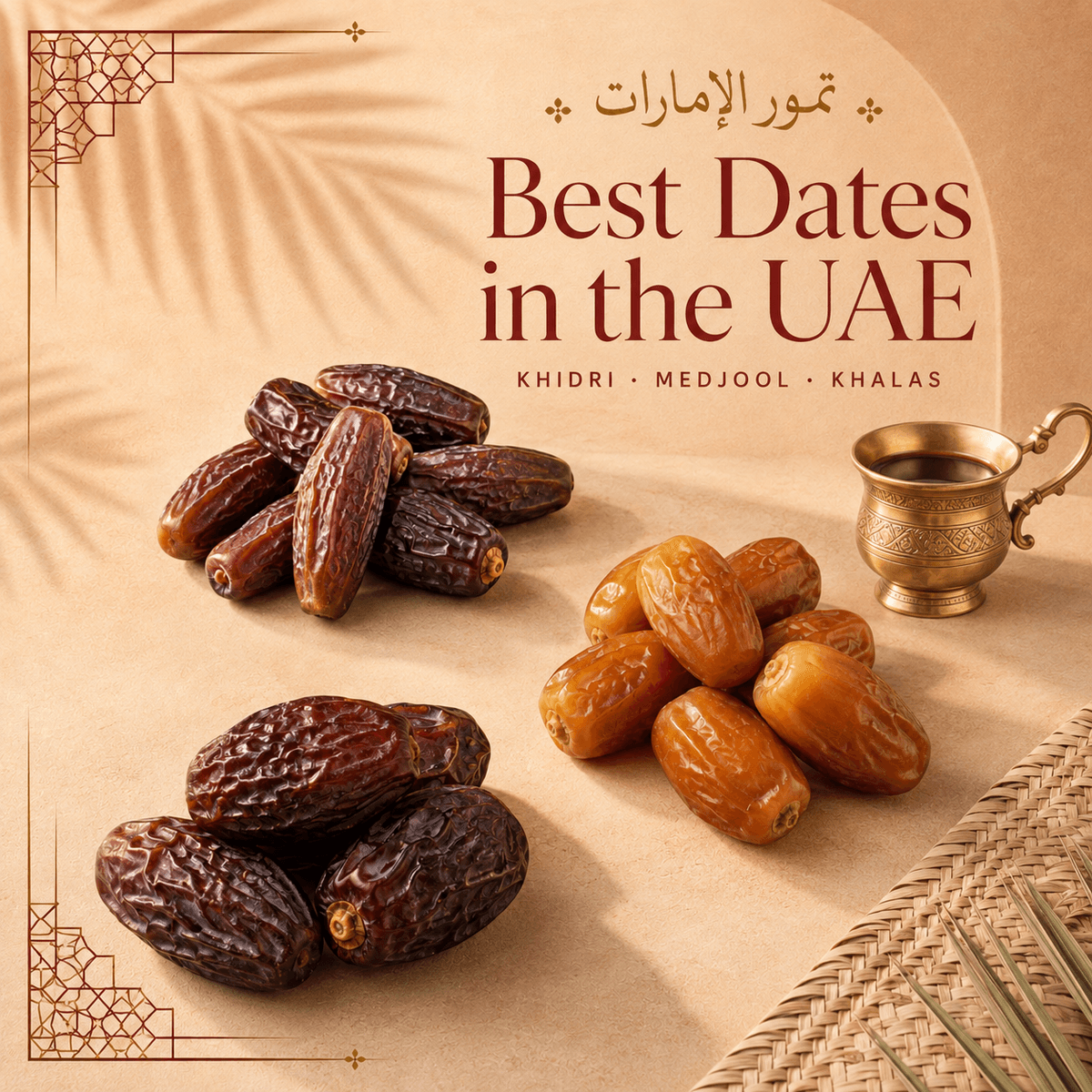
The best dates in the UAE are not all trying to deliver the same experience. Medjool is large, soft, and richly sweet. Khalas has the balanced character many people associate with Gulf hospitality. Khidri sits in a particularly useful middle ground: satisfyingly chewy, deeply flavored, and less syrupy on the palate than many softer varieties.
That makes “best” a question of taste and use, not a medical ranking. This guide compares three standout varieties available in Dubai and across the UAE, explains what dates genuinely contribute nutritionally, and separates the real meaning of organic certification from the marketing language around it. Khidri gets extra attention because it is also the organic date variety YallaYum transforms into Dubai Crunch Saffron & Rosewater.
Blog
How We Chose the Best Dates in the UAE
There are thousands of named date-palm cultivars worldwide, and fruit characteristics can change substantially with variety, ripeness, climate, irrigation, and post-harvest handling. The Food and Agriculture Organization notes wide variation in date size, color, taste, moisture, and consistency. A single list claiming one variety is universally healthiest would ignore those differences.
Our three selections reflect distinct reasons people buy dates in Dubai:
- Khidri for balanced sweetness, dense chew, and everyday versatility
- Medjool for a soft, substantial bite and premium presentation
- Khalas for regional familiarity, balanced flavor, and Emirati hospitality
All three can be good choices. The right one depends on whether you are filling a snack bowl, assembling a gift, serving Arabic coffee, baking, or looking for a completely different texture.
The Three Varieties at a Glance
| Variety | Typical flavor | Texture | Best suited to | What makes it stand out |
|---|---|---|---|---|
| Khidri | Deep date flavor, caramel notes, moderately sweet on the palate | Dense, chewy, semi-dry | Everyday snacking, coffee service, recipes, modern date products | Balanced rather than syrupy, with enough structure to hold its character |
| Medjool | Rich caramel and honey-like sweetness | Large, soft, moist, and fleshy | Premium gifting, stuffing, smoothies, desserts | A substantial, indulgent bite and strong visual appeal |
| Khalas | Honeyed, caramel-like, and rounded | Tender with a gentle chew | Emirati hospitality, Ramadan tables, coffee pairings | Strong Gulf identity and a sweetness level that feels balanced |
These descriptions refer to typical sensory qualities, not fixed nutrition numbers. Harvest stage and storage can make two packs of the same variety taste noticeably different.
1. Khidri: The Balanced Everyday Choice
Khidri, also spelled Khudri or Khodri, deserves more attention than it usually receives in generic date guides. The fruit is generally medium to large, dark reddish-brown, and chewy without feeling dry. Its flavor is full but not as intensely syrupy as a very soft Medjool.
That balance is Khidri's advantage. It works beside unsweetened Arabic coffee because it adds sweetness without dominating the cup. It can be chopped into oats, blended into snack mixtures, served with nuts, or eaten on its own. The firmer body also gives it more presence than a date that collapses into paste as soon as it is handled.
Khidri should not be promoted as automatically “low sugar.” Cultivar studies show that sugar composition and glycemic response vary, but serving size, ripeness, and growing conditions matter too. A less sweet taste does not prove a lower sugar content. The honest reason to choose Khidri is its flavor and texture profile.
For YallaYum, Khidri also represents the bridge between heritage and modern food technology. We use organic Khidri dates as the base for Dubai Crunch, infuse them with real regional ingredients, and freeze-dry them in Dubai. The result keeps the date's recognizable flavor while replacing the familiar chew with a light, crisp structure.
2. Medjool: The Soft, Premium Classic
Medjool is the variety most shoppers recognize immediately. It is large, plump, soft, and naturally rich, with a flavor often compared to caramel. The FAO describes Medjool as a high-value commercial variety known for fruit quality and size, which helps explain its frequent appearance in premium gift boxes.
Choose Medjool when the date itself needs to feel indulgent. Its size makes it easy to split and fill with tahini, nut butter, cheese, or whole nuts. Its soft flesh also blends smoothly into shakes, sauces, and homemade snack balls.
That generous size changes portion expectations. The USDA FoodData Central entry for Medjool dates lists one pitted 24 g date at roughly 66 calories, with about 18 g of carbohydrate and 1.6 g of fiber. Those values are useful references, but they should not be applied to every date variety or every fruit size.
Medjool is one of the best dates in the UAE for gifting and dessert-style snacking. For a smaller, firmer, less intensely sweet bite, Khidri is often the more practical everyday option.
3. Khalas: A Gulf Favorite with Local Character
Khalas belongs in this selection because it feels rooted in the region. It is cultivated in the UAE and elsewhere in the Gulf, and its amber-brown fruit is known for a rounded, honeyed flavor and a tender but controlled chew. The official Ras Al Khaimah guide to buying and eating dates includes Khalas among the varieties widely enjoyed in the country and places dates firmly within local food culture and hospitality.
Khalas works particularly well with Arabic coffee. It is sweet enough to soften the coffee's bitterness, but usually not as heavy on the palate as a large Medjool. It also feels appropriate on Ramadan tables, in a majlis, or as part of a locally inspired gift.
If Medjool is the international premium classic and Khidri is the versatile everyday choice, Khalas is the regional reference point. It gives a first-time visitor to Dubai a useful introduction to the flavor profile people across the Gulf already know well.
What Are the Health Benefits of Dates?
Dates are naturally sweet fruit, not sugar-free food. Their main contribution is carbohydrate, accompanied by fiber, potassium, smaller amounts of other minerals, and plant compounds such as phenolics. A recent scientific review of date-palm fruit describes dates as predominantly carbohydrate-containing fruit with fiber, low fat, minerals, and diverse bioactive compounds.
The practical benefits are more straightforward than many online claims suggest:
- Quick food energy: Dates contain naturally occurring glucose and fructose, making them convenient before activity or during a long day.
- Dietary fiber: Whole dates retain fiber, unlike refined table sugar or most syrups.
- Potassium and other minerals: The exact amount changes with cultivar, soil, maturity, and portion size.
- Useful sweetness in recipes: Dates can replace some refined sweeteners while adding texture and small amounts of nutrients.
- Easy pairing: Combining dates with nuts, plain yogurt, or another protein-containing food creates a more complete snack than eating a large portion alone.
A study conducted in the UAE measured the glycemic index of five common date varieties and reported relatively low values in both healthy participants and participants with type 2 diabetes. That finding is interesting, but it is not permission to ignore portion size. The study was small, and a food's glycemic index does not show how much carbohydrate you eat in one sitting. The full study is indexed by the U.S. National Library of Medicine.
Dates remain concentrated in natural sugar and calories. If you monitor blood glucose or follow a medically prescribed diet, use the package nutrition panel and advice from your healthcare professional rather than relying on a general “healthy” label.
For a wider comparison of naturally sweet snack choices, see YallaYum's guide to healthy alternatives to sweets.
Organic vs. Conventional Dates: What Actually Changes?
The biggest difference between organic and conventional dates is how the fruit is farmed, handled, documented, and certified. It is not a guarantee that one date contains less natural sugar or dramatically more vitamins.
| Question | Certified organic dates | Conventional dates |
|---|---|---|
| How are they produced? | Must follow an approved organic production standard with restrictions on inputs and documented controls | May use permitted conventional agricultural inputs within applicable residue and food-safety limits |
| Does organic mean pesticide-free? | No. Organic systems restrict synthetic pesticides and allow only specified inputs; “organic” is not the same as “never treated” | Approved pesticides may be used according to local rules and good agricultural practice |
| Are they always more nutritious? | Not proven for dates. Broader crop research finds some compositional differences, but they are generally modest and inconsistent | Can provide the same core date nutrients, including carbohydrate, fiber, and minerals |
| Do they contain less sugar? | Not necessarily. Natural sugar is driven mainly by cultivar, ripeness, moisture, and serving size | The same factors determine natural sugar concentration |
| Does organic mean no added sugar? | No. Organic describes the production system. A processed organic product could still contain added ingredients | Check the ingredient list for sugar, syrup, coatings, oil, or preservatives |
| What should a UAE shopper verify? | A recognized organic certification and a clear ingredient list | Source, pack integrity, ingredient list, quality, and storage conditions |
The UAE regulates organic inputs and products under Federal Law No. 5 of 2009. The country's organic product conformity framework also requires certification where a supplier wants to place an organic mark on a regulated product label. In other words, “organic” should be supported by certification, not used as a loose synonym for natural.
Broader research comparing organic and conventional agriculture has found lower pesticide-residue frequency in organic crops and some modest differences in certain compounds. It has not established that every organic food is nutritionally superior. A comprehensive review published in *Environmental Health* describes the evidence and its limitations clearly. You can read the full organic-food review.
For shoppers, the sensible hierarchy is simple: choose a date variety you enjoy, check the ingredient list, verify organic certification if that claim matters to you, and manage the portion. Paying more for organic does not turn natural fruit sugar into a free food.
YallaYum covers the wider label question in its guide to organic vs. conventional snacks for UAE parents.
How to Choose Good Dates in Dubai
The variety name matters, but handling matters just as much. Dubai's heat makes storage discipline especially important, and humid air can affect texture once a package is opened.
Use this quick check before buying:
1. Read the ingredient list. Whole dates should normally list dates as the only ingredient. If there is glucose syrup, added sugar, oil, or a coating, you are buying a different product. 2. Match appearance to the variety. Soft Medjool should look plump. Semi-dry Khidri should feel firm and chewy rather than hard. Do not reject a date merely because it has natural wrinkles. 3. Check the package. Avoid torn seals, moisture inside the pack, visible mold, fermentation odors, or insect damage. 4. Confirm the claim. If the front says organic, look for certification details rather than relying on green packaging. 5. Buy for the occasion. Medjool suits premium gifting, Khalas fits a traditional Gulf presentation, and Khidri handles daily snacking and modern applications particularly well. 6. Store it properly. Follow the pack instructions. Keep dates sealed, away from direct sunlight and heat, and refrigerate softer varieties when the manufacturer recommends it.
If your goal is a broader snack rotation rather than dates alone, the healthy snacks in Dubai guide explains what to check across different product categories.
A Modern Way to Experience Khidri Dates
The best dates in the UAE do not have to stay in their traditional form. Dubai Crunch begins with real organic Khidri dates, then changes the eating experience through infusion and freeze-drying.
The Saffron & Rosewater variety is fragrant and gently floral. Cardamom & Cinnamon leans warmer and pairs naturally with Arabic coffee. Both are produced in Dubai with no added sugar, so the sweetness still comes from the date itself.
This is where Khidri becomes especially interesting. Its familiar date character remains, but the dense chew gives way to a clean, airy crunch. It is still recognizable as a regional ingredient, only in a format built for modern snacking, coffee service, and gifting.
You can explore the wider YallaYum snack collection, learn more about the company's Dubai manufacturing story, or review its food-safety certifications and awards. Business buyers looking for retail, hospitality, gifting, or private-label formats can also visit the YallaYum business page.
Frequently Asked Questions
What are the best dates in the UAE?
Khidri, Medjool, and Khalas are three of the best dates in the UAE for different reasons. Khidri offers balanced sweetness and a dense chew, Medjool gives a large and soft premium bite, and Khalas brings the honeyed flavor and regional character associated with Gulf hospitality.
Are Khidri dates better than Medjool dates?
Neither is universally better. Choose Khidri when you want a firmer chew, balanced sweetness, and everyday versatility. Choose Medjool when you prefer a larger, softer, more caramel-like date for stuffing, desserts, or premium gifting. Nutrition also varies by source, maturity, and serving size.
Are organic dates healthier than conventional dates?
Organic dates are produced under a certified system that restricts certain agricultural inputs. That does not automatically make them more nutritious. Both organic and conventional dates provide natural sugars, fiber, and minerals. Certification, ingredient transparency, overall diet, and portion size matter more than vague “natural” marketing.
Do organic dates contain less sugar?
Not necessarily. Organic certification describes how dates are grown and controlled, not how much natural sugar the fruit develops. Sugar content depends more directly on cultivar, ripeness, moisture, and portion. Always use the nutrition panel when you need product-specific carbohydrate or sugar information.
How many dates should you eat in a day?
There is no universal number that suits every person. Date size varies considerably, and one large Medjool is not equivalent to one small date. Treat the labeled serving as a reference, account for total carbohydrate and calories, and seek individualized advice if you manage diabetes or another medical condition.
Which date variety is best for gifting in Dubai?
Medjool is a familiar premium option because of its size and soft texture. Khalas gives a gift stronger regional character. For something made in Dubai and less expected, freeze-dried organic Khidri with saffron and rosewater or cardamom and cinnamon offers a modern alternative to a traditional date box.
Why does YallaYum use Khidri dates for Dubai Crunch?
Khidri has a deep date flavor, balanced sweetness, and a dense, chewy structure that makes it a compelling base for transformation. YallaYum uses organic Khidri, infuses it with real regional flavors, and freeze-dries it in Dubai to create a light crunch without adding sugar.
The best dates in the UAE are the ones that fit the moment. Medjool brings softness and scale. Khalas brings Gulf familiarity. Khidri brings balance, versatility, and, in Dubai Crunch, a completely different way to experience a date. Choose your Dubai Crunch flavor and see where tradition goes next.