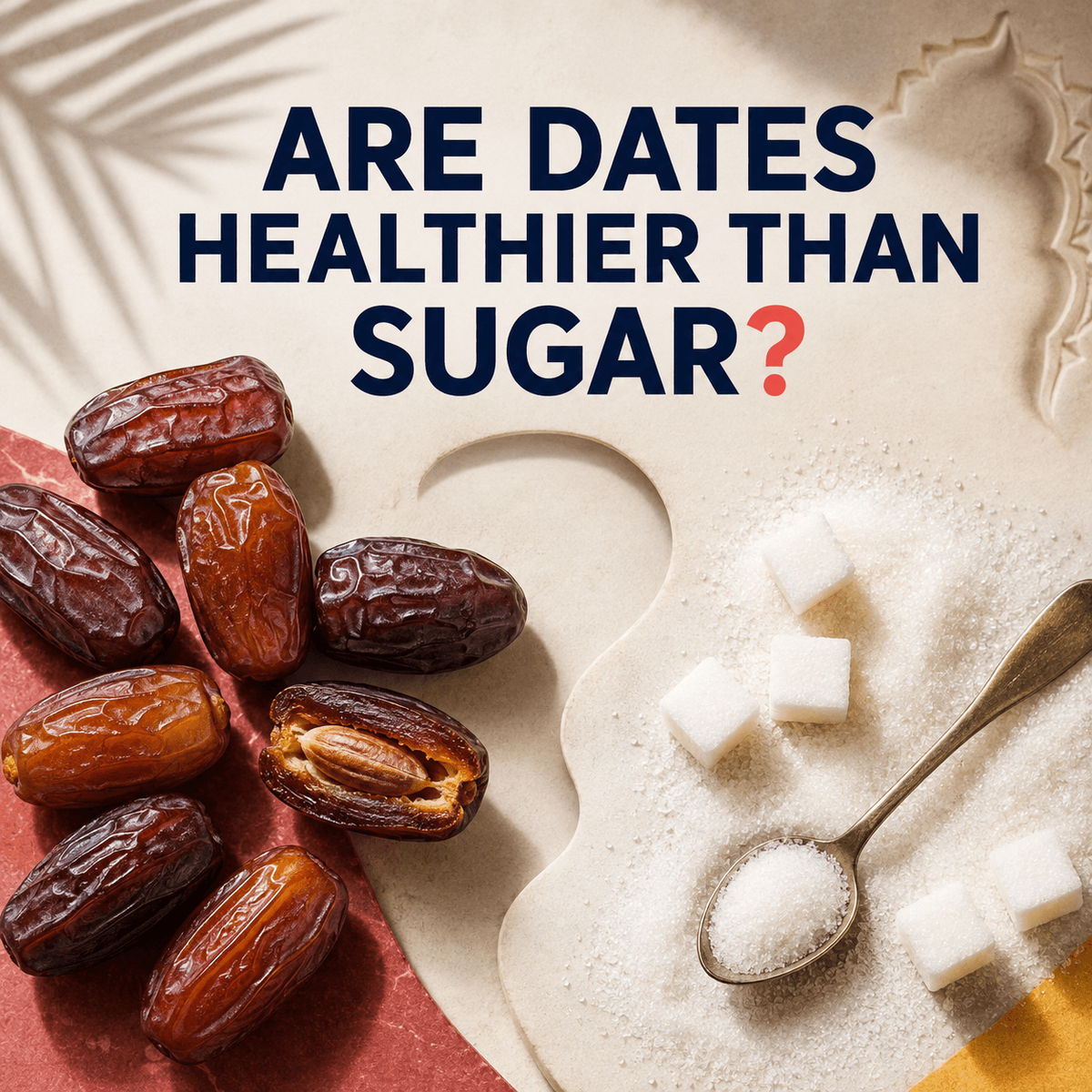
Are Dates Healthier Than Sugar? The Honest Answer
Are dates healthier than sugar? Whole dates usually offer more nutritional value than refined white sugar because they retain fiber, potassium, and other parts of the fruit. That does not make them sugar-free, low-calorie, or unlimited. It also does not mean every sweetener with the word “date” on the label is nutritionally equivalent to a whole date.
That distinction matters in the UAE, where dates appear everywhere from a majlis coffee tray to a protein bar, smoothie, syrup bottle, and “naturally sweetened” dessert. Before deciding that one option is better, check the form, portion, ingredient list, and purpose. YallaYum's guide to no added sugar snacks in the UAE is a useful companion when you are comparing packaged products.
Blog
The Short Answer
If the choice is a measured portion of whole dates or the same weight of white sugar, dates have the stronger nutritional profile. Whole dates provide fiber and small amounts of micronutrients, while granulated sugar is almost entirely sucrose.
But “dates are healthier” needs four qualifications:
1. Form matters. Whole dates, date paste, date sugar, and date syrup are not interchangeable. 2. Amount matters. Dates still contain substantial natural sugar and carbohydrate. 3. Use matters. Date paste can add flavor and moisture to a muffin, but it cannot perform every structural job of granulated sugar. 4. Personal needs matter. Anyone managing diabetes, a medically prescribed diet, or carbohydrate intake needs more than a broad healthy-or-unhealthy label.
The most useful conclusion is not that dates cancel sugar. It is that whole dates can deliver sweetness in a more complete food form.
What Are We Actually Comparing?
Online comparisons often use “dates” to describe five different things. That creates confident answers to the wrong question.
| Form | What it is | Does it retain fruit solids? | How it behaves | Best understood as |
|---|---|---|---|---|
| Whole dates | Intact date fruit, with the pit removed before eating | Yes | Chewy, moist, or semi-dry depending on variety | Fruit and a concentrated source of carbohydrate |
| Date paste | Whole dates processed into a paste, sometimes with water | Usually, if it is made from the whole fruit | Thick, moist, caramel-like, and fibrous | A fruit-based ingredient |
| Date sugar | Dried dates ground into granules or powder | Usually | Coarse, less soluble, and darker than white sugar | Ground whole fruit used as a sweetener |
| Date syrup | A concentrated liquid made from dates | Usually much less fiber than whole dates, but products vary | Pourable and easy to dissolve | A syrup and concentrated sweetener |
| White sugar | Refined sucrose, commonly from cane or sugar beet | No fruit solids | Dry, neutral, soluble, and structurally useful in baking | Added sugar |
Read the ingredient list before relying on the product name. A jar labeled date spread may contain only dates and water, or it may include syrup, oil, flavoring, or another sweetener. Date sugar may be pure ground dates or a blend. Date syrup can also vary in concentration.
If you are choosing dates for eating rather than sweetening, our comparison of the best dates in the UAE explains how Khidri, Medjool, and Khalas differ in flavor, texture, and use.
Dates vs. Sugar Nutrition: What Changes?
The simplest factual comparison uses equal weights, even though 100 g is not a recommended serving of either food. It is a reference that shows what each food contains.
According to USDA FoodData Central's entry for Medjool dates, 100 g provides about 277 calories, 75 g of carbohydrate, 66.5 g of total sugar, 6.7 g of fiber, and 696 mg of potassium. The USDA entry for granulated sugar lists about 387 calories, almost 100 g of carbohydrate and sugar, and no fiber per 100 g.
| Per 100 g reference | Medjool dates | Granulated white sugar |
|---|---|---|
| Calories | About 277 | About 387 |
| Total carbohydrate | About 75 g | About 100 g |
| Total sugar | About 66.5 g | About 100 g |
| Dietary fiber | About 6.7 g | 0 g |
| Potassium | About 696 mg | Negligible |
These numbers do not prove that any amount of dates is better than any amount of sugar. They show that whole Medjool dates include water, fiber, and micronutrients that refined sugar does not. They also show that dates remain energy-dense and naturally high in sugar.
Date variety makes a difference. A large Medjool is not equivalent to a smaller Khidri or Khalas. Ripeness, moisture, growing conditions, and serving size also affect the final numbers. Use the nutrition panel on the product you are eating when precise carbohydrate counting matters.
The table should not be copied onto date sugar or date syrup. Grinding, concentrating, filtering, adding water, and commercial formulation can change the values per spoonful.
Natural Sugar vs. Added Sugar
“Natural sugar” describes sugar that is already present in a food such as fruit or milk. “Added sugar” describes sugar introduced during preparation or manufacturing. Total sugar on a nutrition panel can include both.
An intact date contains glucose, fructose, and, depending on the variety and maturity, sucrose. Those sugars occur naturally within the fruit. If a snack contains only dates, its nutrition panel can still show a high total-sugar number without white sugar having been added.
That does not mean all natural-sounding sweeteners sit outside sugar guidance. The World Health Organization's current healthy-diet guidance defines free sugars to include sugars added by a manufacturer, cook, or consumer, as well as sugars naturally present in honey, syrups, fruit juices, and juice concentrates. Under that public-health definition, date syrup is still a syrup.
The U.S. FDA's consumer explanation of added sugars makes a similar practical distinction between sugars naturally present in fruit and sugars supplied through table sugar, honey, syrups, and concentrated juices. UAE labeling rules are not identical to U.S. rules, so use these definitions to understand the concept, not to interpret a local legal claim in isolation.
Does “no added sugar” mean low sugar?
No. It means sweetness was not increased with added sugar or another qualifying sweetening ingredient under the applicable labeling rules. A date product may contain no added sugar and still contain plenty of the fruit's natural sugar.
This is why the ingredient list and nutrition panel need to be read together:
- The ingredient list tells you where the sweetness comes from.
- Total sugar tells you how much sugar is present from all sources.
- Serving size tells you how much of the food those numbers describe.
- Claims on the front of the pack give context, but they do not replace the details on the back.
Do Dates Spike Blood Sugar?
Dates raise blood glucose because they contain digestible carbohydrate. The size of the rise depends on the variety, portion, food combination, and individual response.
A small UAE study measured the glycemic index of five date varieties in people without diabetes and people with type 2 diabetes. The reported mean GI values in the healthy group ranged from about 46 to 55. The full results are available through the U.S. National Library of Medicine. That is useful evidence, but it does not support a single universal GI number for all dates.
Other research has reported a wider range across varieties and maturity stages. GI also describes the response to a standardized amount of available carbohydrate. It does not tell you how much carbohydrate is in the portion you actually eat. Glycemic load, portion size, and the rest of the meal matter.
A 2022 randomized trial compared daily date or raisin intake in adults with type 2 diabetes over 12 weeks. It did not find a significant improvement in the primary glycemic measures, but it also did not find that the tested 60 g daily portion worsened them. One study is not a personal meal plan, and its result should not be transferred to date syrup, date sugar, or every variety.
Can people with diabetes eat dates?
Many can, but the portion must fit their individual carbohydrate plan, medication, glucose response, and professional advice. Whole dates are not a treatment for diabetes, and a lower GI result does not make them a free food.
Useful habits include counting the actual grams of carbohydrate, noticing date size, and pairing the portion with a meal or snack that contains protein or fat when appropriate. For a wider discussion of timing and portion context, read our guide to the best time to eat dates.
Can Date Paste Replace Sugar in Baking?
Sometimes. Date paste works best when its moisture, color, flavor, and dense texture suit the recipe.
It can be useful in:
- Oat bars and energy bites
- Brownies and fudgy bakes
- Banana bread, carrot cake, and other moist quick breads
- Smoothies and blended breakfast bowls
- Homemade sauces where a darker fruit flavor is welcome
It is much less suitable for:
- Meringue
- Crisp shortbread
- Light sponge cakes that rely on creaming butter and sugar
- Clear drinks where complete dissolution matters
- Pale desserts where the brown color changes the intended appearance
Granulated sugar does more than sweeten. Its crystals help aerate butter during creaming, influence browning, control moisture, and contribute to structure. Date paste brings water and fruit solids, so a straight cup-for-cup replacement can make a bake darker, softer, or denser.
There is no dependable universal substitution ratio because date-paste thickness, date variety, recipe structure, and desired sweetness all vary. Start with a recipe developed for date paste, or test a partial replacement before changing an entire batch. That is more reliable than treating a viral swap chart as food science.
The wider scientific literature also treats date fruit as a promising sweetening ingredient rather than a drop-in copy of sucrose. A 2023 review of date fruit as an alternative to sweeteners discusses its fiber, sugar profile, phytochemicals, and food applications, while also showing how composition varies by cultivar and processing.
Date Sugar vs. White Sugar
Date sugar is generally made by drying whole dates and grinding them. Because the fruit solids remain, it may retain some fiber, minerals, and plant compounds. White sugar does not.
That gives date sugar a nutritional edge in composition, but not a free pass. It is still a concentrated source of sweetness and carbohydrate. There is also far less human research on date sugar itself than on whole dates. A glycemic-index study using whole fruit cannot be cited as proof that every commercial date sugar has the same blood-glucose effect.
In the kitchen, date sugar behaves differently:
- It does not dissolve as cleanly as white sugar.
- It can leave visible specks in tea, coffee, or a pale batter.
- It adds a darker, caramel-like fruit flavor.
- It can absorb moisture and produce a denser result.
- Product granulation and sweetness vary, so the package directions matter.
Choose date sugar when you want the flavor and whole-fruit solids. Choose white sugar when a recipe depends on neutral sweetness, full dissolution, or precise crystalline structure. Neither choice makes portion size irrelevant.
Date Syrup vs. Sugar
Date syrup is convenient because it pours and dissolves easily. It works in coffee, tahini dressings, marinades, oatmeal, and desserts where a liquid sweetener fits the recipe.
Its main tradeoff is that it does not behave like a whole date nutritionally. Depending on how it is made, much of the fruit's insoluble material and fiber may be absent, while the sugars are concentrated into an easy-to-pour form. The exact nutrition varies by brand, so check the panel rather than assuming a standard number.
From a public-health perspective, replacing one spoonful of white sugar with an unlimited pour of date syrup misses the point. WHO includes sugars naturally present in syrups within free sugars. Date syrup may contribute flavor and small amounts of compounds not found in refined sugar, but it is still a sweetener to measure.
The same logic applies to honey, maple syrup, agave, and coconut sugar. “Natural,” “unrefined,” and “plant-based” describe origin or processing. They do not mean sugar-free.
How to Choose the Right Option in the UAE
The best choice depends on the job you need it to do.
| Your goal | Most practical option | Why | What to watch |
|---|---|---|---|
| A snack with Arabic coffee | A measured portion of whole dates | Recognizable fruit, fiber, and regional fit | Date size and portion |
| Sweetness in a smoothie | Whole pitted dates or date paste | Blends sweetness with fruit solids | Total carbohydrate across the whole drink |
| A pourable topping | Date syrup | Dissolves and drizzles easily | It remains a concentrated syrup |
| Crisp cookies or meringue | Granulated sugar | Provides structure and predictable dissolution | Added-sugar amount |
| Dense muffins or oat bars | Date paste or partial replacement | Moisture and caramel flavor suit the format | Recipe balance and browning |
| A dry topping for oats | Date sugar | Adds granular sweetness with date flavor | It may not dissolve fully |
| A portable date experience | Whole dates or a measured date snack | Easy to carry and portion | Heat, pack integrity, and serving size |
For a Business Bay desk drawer or a long drive between emirates, packaging matters almost as much as the ingredient. Keep date products sealed, away from direct sun, and within the storage conditions on the pack. An August car is not a pantry.
At the supermarket, use this five-step check:
1. Read the product name carefully. Whole dates, paste, sugar, spread, and syrup are different formats. 2. Check the ingredient list. Look for added cane sugar, glucose syrup, oils, juice concentrates, or coatings. 3. Compare equal serving sizes. A tablespoon, one large Medjool, and five small dates are not equivalent portions. 4. Look at total carbohydrate and total sugar. “No added sugar” does not erase the naturally occurring sugar. 5. Buy for the occasion. The best ingredient for a brownie is not automatically the best snack for a school bag or coffee tray.
If your real goal is to replace a packaged sweet rather than reformulate a recipe, our guide to healthy alternatives to sweets compares several practical options. The broader healthy snacks in Dubai guide covers portability, ingredients, and everyday use.
Where Dubai Crunch Fits
Dubai Crunch is not a spoonable sugar replacement. It is YallaYum's crisp take on a date snack, made with organic Khidri dates, paired with real regional flavors, and freeze-dried in Dubai. It contains no added sugar, but it still contains the date's naturally occurring sugar and carbohydrate.
That makes its role clear. Choose it when you want the recognizable flavor of a date in a light, crisp format for snacking, coffee service, travel, or gifting. Do not treat it as sugar-free food or assume that freeze-drying removes calories or natural sugar. Freeze-drying changes the texture by removing moisture. It does not make the date's carbohydrate disappear.
The two current 30 g resealable cans take different flavor directions:
- Saffron & Rosewater is floral, fragrant, and suited to a refined coffee or tea presentation.
- Cardamom & Cinnamon is warmer and spice-led, with a natural connection to Arabic coffee.
The detailed production method remains part of YallaYum's in-house know-how. For shoppers, the useful facts are the date variety, flavor direction, texture, portion, ingredient information, and label.
If you want more context before choosing, read what Dubai Crunch is and how the flavors differ, or browse the wider YallaYum snack collection.
Frequently Asked Questions
Are dates healthier than sugar?
Whole dates generally offer more nutritional value than refined white sugar because they retain fiber, potassium, and fruit solids. They are still high in naturally occurring sugar and carbohydrate, so portion size matters. The advantage is a more complete food, not the absence of sugar or calories.
Are dates sugar-free?
No. Dates are naturally sweet fruit and contain glucose, fructose, and varying amounts of sucrose. A date product can have no added sugar while still listing substantial total sugar on its nutrition panel. “No added sugar” and “sugar-free” are different claims and should not be used interchangeably.
Is date sugar healthier than white sugar?
Date sugar usually retains some fruit solids, fiber, minerals, and plant compounds that white sugar lacks. However, it remains a concentrated sweetening ingredient, and research on date sugar itself is limited. It also behaves differently in recipes, especially where complete dissolution or crystalline structure is important.
Is date syrup healthier than regular sugar?
Date syrup can offer a richer flavor and may contain small amounts of compounds absent from refined sugar, but it remains a concentrated syrup. It usually has much less fiber than whole dates. WHO classifies sugars naturally present in syrups as free sugars, so the amount still deserves attention.
Can I replace sugar with date paste in baking?
Date paste can replace some sugar in moist, dense recipes such as brownies, oat bars, and quick breads. It adds water, fruit solids, color, and flavor, so it is not a universal cup-for-cup swap. Recipes that rely on sugar crystals for lift or crispness need more careful reformulation.
Do dates spike blood sugar?
Dates raise blood glucose because they contain carbohydrate. The response varies with date variety, ripeness, portion, meal composition, and the individual. Some whole-date studies report low-to-moderate glycemic-index values, but that evidence does not apply automatically to date syrup, date sugar, or unlimited portions.
Can people with diabetes eat dates instead of sugar?
Some people with diabetes can include a counted portion of dates in an individualized eating plan. Dates are not a treatment, and replacing sugar with dates does not remove carbohydrate. Use the product's nutrition panel, monitor personal response when advised, and follow guidance from a qualified healthcare professional.
Does freeze-drying remove sugar from dates?
No. Freeze-drying removes moisture and changes texture, but it does not selectively remove the date's natural sugar, carbohydrate, or calories. A freeze-dried date may feel lighter and crisper than a chewy date, so use the labeled serving size rather than judging the portion by volume alone.
Are Dates Healthier Than Sugar? The Bottom Line
Are dates healthier than sugar? In their whole-fruit form, they bring fiber, fruit solids, and micronutrients that refined sugar does not. The advantage becomes smaller as the fruit moves toward a concentrated syrup, and none of the forms makes sweetness unlimited. Choose the format that fits the food, measure the portion, and read the label.
For a date snack that keeps the sweetness naturally within the fruit and changes the familiar chew into a crisp Dubai-made bite, choose your Dubai Crunch flavor.