Freeze-Dried Fruit for Cafes: A Topping Service Guide
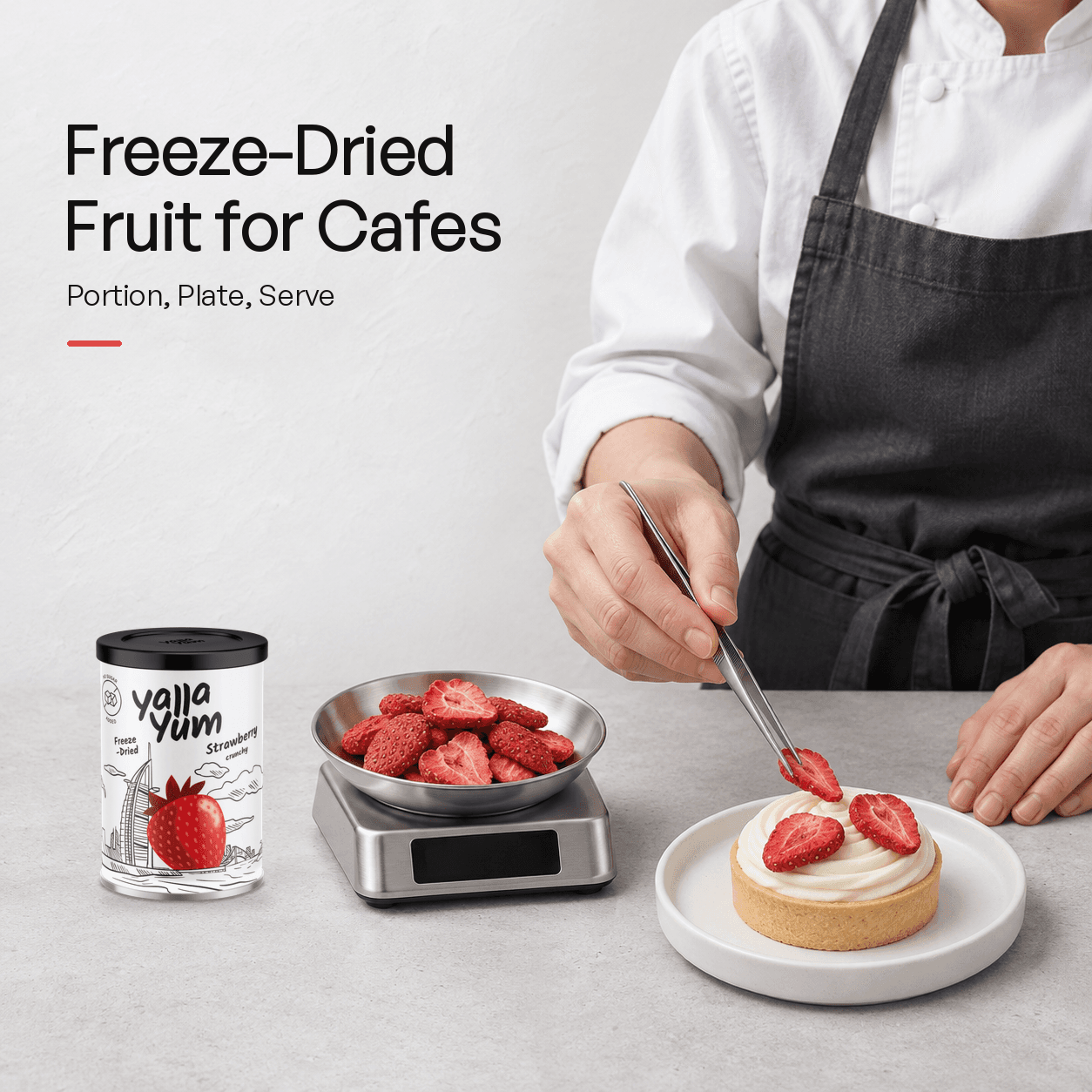
The practical starting point for freeze-dried fruit for cafes is one menu item and one weighed portion. Decide what the fruit should contribute, calculate the cost from your actual purchase price and usable grams, then check the result through preparation, handover and eating.
YallaYum accepts cafe and foodservice supply inquiries for freeze-dried fruit ingredients. Discuss the application and required format before assuming that a particular pack size or specification is available.
A strawberry finish on a breakfast bowl may look right at the pass but soften before the customer starts eating. A neat garnish may also weigh more than the portion in your costing sheet. The trial should answer both questions.
Blog
Start With One Dish and One Job
Pick an existing item your team already prepares consistently. A Business Bay breakfast counter might start with a yogurt bowl; a pastry team in Abu Dhabi might choose a plated cheesecake.
Write down what you want: a recognizable fruit garnish, scattered texture or fruit mixed through a filling. Each calls for a different preparation.
| Application to trial | Starting format | What to assess |
|---|---|---|
| Yogurt bowl or plated dessert | Pieces or coarse crumbs | Appearance, texture at eating time and portion weight |
| Finished pastry or cookie | Crumbs | Coverage, adhesion and how it travels |
| Frosting or glaze | Fine powder | Flavor, consistency and even mixing |
| Cream-topped drink | Pieces or crumbs added at handover | Contact with liquid, lid clearance and drinking experience |
These are trial ideas, not tested YallaYum menu recipes. Begin with a small quantity and an agreed result rather than adding the fruit across several dishes at once.
Choose Pieces, Crumbs or Powder
Pieces give the customer something recognizable. Crumbs provide smaller, scattered bites. Powder is useful when the intention is to mix fruit through a preparation.
King Arthur Baking's fruit-powder guide describes grinding freeze-dried fruit for use in frostings, doughs and other baking applications. If your team prepares powder from pieces, use suitable clean, dry equipment and a recipe that accounts for the fruit.
Keep that preparation separate from a claim that a ready-made powder SKU is available. The current YallaYum product range is a starting point for sampling; ask about foodservice requirements directly.
For baked applications, our freeze-dried fruit baking guide provides broader context. For drink inspiration, the YallaYum strawberry cream latte recipe shows a different preparation from a dry finishing garnish.
Calculate Topping Cost per Serving
Use the weight your team actually serves. A spoonful or a count of pieces can vary, especially when fragment sizes differ.
The calculation is:
Topping cost per serving = pack cost ÷ usable grams × grams per serving
Keep the units consistent: AED for cost and grams for both weights. For a carton, use the total ingredient cost and total usable weight for that same carton.
BCcampus's foodservice yield-testing guidance explains the underlying principle: portion cost should reflect usable product, rather than purchase weight alone. Apply that principle to the format your dish requires.
An illustrative example
The following numbers are invented to demonstrate the calculation. They are not YallaYum prices, pack sizes or expected yields.
| Input or result | Illustrative value |
|---|---|
| Ingredient pack cost | AED 60.00 |
| Net fruit weight purchased | 300 g |
| Usable weight for the selected application | 270 g |
| Fruit per serving | 3 g |
| Potential servings at that portion | 270 ÷ 3 = 90 |
| Topping cost per serving | 60 ÷ 270 × 3 = approximately AED 0.67 |
In this hypothetical case, 30 g is unavailable to the selected application. Don't automatically classify all crumbs as waste: they may suit the recipe. Measure what your own trial can use and record genuine losses separately.
If all 300 g were usable at the same portion size, the ingredient cost would be AED 0.60 per serving. That difference illustrates why actual yield matters.
This calculation covers the fruit ingredient only. It doesn't establish the finished dish's food cost, labor cost, selling price or profit. Account for other ingredients, preparation and any allocated purchasing or delivery costs through your normal costing method.
Copy these fields into your costing sheet
Item / supplier: __________ Price checked on: __________
Pack cost, AED: __________ Net weight, g: __________
Usable weight, g: __________ Portion weight, g: __________
Cost per serving, AED: __________ Measured losses / notes: __________
Recalculate when the purchase price, usable yield or serving portion changes.
Set Up a Small, Dry Service Station
Keep the reserve supply closed and bring a manageable amount to the finishing station. Use a clean, dry food container with a tight-fitting lid and a dedicated dry utensil.
Utah State University's dry-food packaging guidance emphasizes closed containers that protect against moisture. At a cafe counter, position the fruit away from the espresso steam wand, dishwasher and wet preparation area.
Keep the product name, lot information, opening date and storage instructions available. Follow the supplier's directions and your kitchen's food-safety procedures for handling and replenishment. Don't pour used service stock back into the reserve supply or assume a new container creates a new shelf life.
Write a short plating note: the selected format, target weight, placement and point of addition. Include a reference photograph so different shifts can reproduce the intended finish.
Run the Trial Through Actual Service
Check the dish as the customer will receive it. For a Dubai takeaway order, include the container, lid and expected handover delay in the trial.
1. Prepare the normal base. Use the same recipe and serving temperature your team intends to sell. 2. Weigh the fruit. Record the portion, including any preparation losses. 3. Add it at the planned stage. For a crisp garnish, try finishing close to handover. Liquid contact can change the texture. 4. Check after the real service delay. Assess appearance, flavor, texture and packaging fit. A photograph alone can't confirm the eating experience. 5. Repeat with the staff who will serve it. Record portion variation and ease of preparation before adopting the method.
There is no universal period for which fruit stays crisp on every dessert or drink. Your trial should determine whether that particular application delivers the experience you intend.
Prepare Your Foodservice Supplier Inquiry
Once you have a workable application, request the information needed to repeat it. Our UAE business-buyer guide covers broader sourcing questions; for this inquiry, lead with the dish.
Include:
- Venue and delivery location: cafe, pastry kitchen or hotel breakfast operation, with the emirate and address area.
- Application: the dish or drink, and the result you're trying to achieve.
- Fruit and format: pieces, crumbs or powder requested for assessment, including size preferences.
- Expected quantity: trial needs and an estimated monthly amount, clearly marked as an estimate.
- Packing and information needs: pack format, ingredient and allergen details, traceability, storage instructions and remaining shelf life.
- Timeline and quotation: required trial date, expected ordering pattern and a request to confirm price, minimum order and lead time.
Availability and specifications need confirmation for the order. Describe your ideal format without assuming every requested option is already stocked.
Frequently Asked Questions
When should cafes add a freeze-dried fruit topping?
If crisp texture is the goal, start by adding it near handover, then assess the dish after the delay your service normally involves. Moisture from cream, yogurt or a drink can change the texture. A fruit ingredient mixed through frosting has a different purpose from a crisp garnish.
Can broken pieces still be used?
Yes, if they are sound, properly handled and suitable for the intended preparation. Smaller fragments may work as crumbs or be ground for a recipe. Record their use in your yield calculation. Breakage alone doesn't mean waste, but damage, contamination or poor condition needs a separate assessment.
Does a larger pack always mean a lower topping cost?
No. Compare purchase cost with the amount your team can actually use and the portion served. A larger pack can have a lower price per purchased gram while still being a poor fit for your usage rate or handling routine. Confirm the available formats and measure your own yield.
Put One Application Into Practice
Choosing freeze-dried fruit for cafes becomes easier when you have a dish, a portion weight and a service method to discuss. Start with one application, cost it using actual inputs and check the eating experience before extending it across the menu.
Send the application, estimated monthly quantity, preferred format and delivery location through YallaYum's foodservice inquiry form to discuss suitable supply options.